
Have we ever seen crazier weather during the month of March in the United States? Literally dozens of high temperature records have been shattered in the Southwest. Meanwhile, a very alarming series of historic droughts stretches all the way from the beaches of southern Florida to the mountains of northern Colorado. It is not supposed to be so hot and so dry this time of the year, and these brutal conditions are creating an ideal environment for wildfires. Fire season hasn’t even arrived yet, but absolutely horrific wildfires are already running rampant in some areas of the country. If things are this bad now, what will they look like once we reach the middle of the summer?
In recent days, a colossal heat dome has been baking the living daylights out of the Southwest…
After smashing March heat records in 14 states and the U.S. as a whole, the gigantic heat dome that’s baked the Southwest is creeping eastward and may end up being one of the most expansive heat waves in American history, meteorologists and weather historians said.
And it’s not going away for awhile, maybe not till the middle of the next week as April starts, said meteorologist Gregg Gallina of the National Weather Service’s Weather Prediction Center.
“Basically the entire U.S. is going to be hot,” Gallina said Monday. “The area of record temperatures is extremely large. That’s the thing that’s really bizarre.”
Throughout most of the nation, it is going to feel like summer this week, but we are only in the very early days of spring.
What in the world is going on?
According to Accuweather meteorologist Jesse Ferrell, “hundreds of daily record highs” have been getting broken, and this heat wave is far from over…
Many locations from California to parts of Colorado and Texas have tied or broken daily record highs for a long string of days. Some have shattered old records by several degrees. Some have set new early-season high temperature records, wiping out marks set in March and April, even though April is still a week away.
“So far, we have counted 76 individual monthly temperature records being set and hundreds of daily record highs,” AccuWeather Meteorologist and Social Media Producer Jesse Ferrell said. “Multiple monthly state records have likely been set during the heat wave so far, with data still being verified by government sources.”
Cities that have tied or broken daily record highs for multiple consecutive days are too numerous to mention, but some include San Francisco, Sacramento, Fresno and Palm Springs, California; Las Vegas, Reno and Ely, Nevada; Phoenix, Flagstaff and Tucson, Arizona; Salt Lake City, Ogden and Cedar City, Utah; Pocatello and Boise, Idaho; Albuquerque, Santa Fe and Las Cruces, New Mexico; El Paso, Texas; and Durango, Colorado.
It was such a cold winter.
But now it suddenly feels like we are in the month of August.
If you can believe it, the high temperature in four locations in Arizona and California actually reached 112 degrees on Friday…
On Friday, four places in Arizona and California hit 112 degrees, according to the Weather Service. Not only did that smash the record for the hottest March day in the continental United States by 4 degrees, but it was only 1 degree shy of the hottest day recorded in the Lower 48 in April.
112 degrees in the month of March.
That is crazy!
In Phoenix, Monday was the sixth day in a row when the high temperature hit at least 100 degrees…
“Phoenix has never experienced more than five days in a row with highs of 100 degrees Fahrenheit or greater during March or April,” DePodwin said. “There are a couple of days with a high near 100 forecast this week, but if temperatures surpass the upper 90s on those days, we could be looking at 10 days in a row of triple-digit heat.”
As of Monday afternoon, that string of days with 100-degree highs reached six in a row. The high on Monday was 100 on the nose.
Okay, I will concede that it is always hot in Phoenix.
But how do you explain what is going on in Denver?
On Tuesday, Denver broke a high temperature record that had stood for 130 years…
Denver broke a 130-year-old heat record for March 24. The previous record was 76 degrees, set in 1896. As of 1 p.m. on Tuesday, the National Weather Service had Denver at 78 degrees.
This continues a stretch of unseasonably warm temperatures for Colorado in March.
Last Saturday marked the peak of this early-season heat wave, with Denver International Airport climbing to 86 degrees, setting a record for the warmest temperature ever recorded in March. While the airport fell just short of 90 degrees, many communities across the plains surged into the low 90s — an extraordinary feat for March.
In all my days, I have never seen anything quite like this.
But it hasn’t just been hot.
For months, there has been a very alarming lack of precipitation in much of the western half of the nation.
As a result, world famous ski resorts in Colorado and Utah have had “shockingly bare slopes”…
At ski resorts across the West this winter, viral images showed chairlifts idling over brown terrain in places normally renowned for their frosty appeal. Iconic mountain towns like Aspen, Colorado, and Park City, Utah, were seen with shockingly bare slopes, as the region endured a historic snow drought that experts warn could bring water shortages and wildfires in the months ahead.
“It’s been a long time since it’s been this bad,” said Russ Schumacher, Colorado’s state climatologist and the director of the Colorado Climate Center, a research initiative at Colorado State University that tracks extreme weather.
He said Colorado hasn’t experienced such a severe snow drought in more than 40 years. Neither has Utah, said Jon Meyer, that state’s assistant climatologist, and newly released federal drought data show similar conditions in New Mexico and Arizona. All four states are contending with record-low snowpack, which is the accumulation of mountain snow that fortifies rivers, reservoirs and drinking water systems once it melts.
Needless to say, it hasn’t just been a few western states that have been experiencing drought.
As you can see from the latest map from the U.S. Drought Monitor, the vast majority of the country is currently experiencing at least some level of drought…
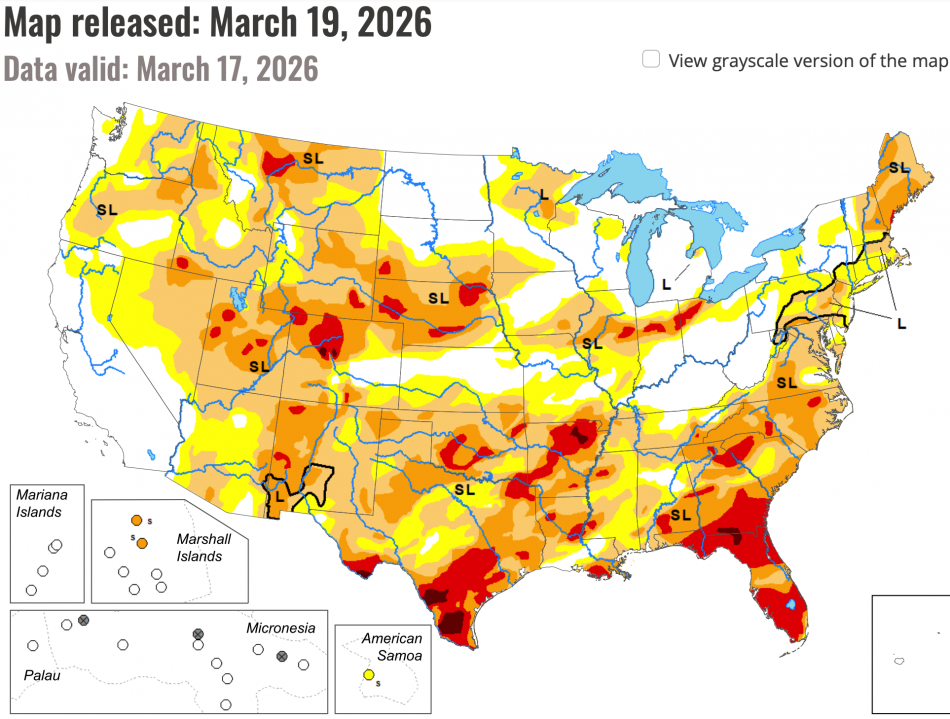
In certain areas, drought has been a major problem for years, and a breaking point is rapidly approaching.
For example, it is being projected that before the end of 2026 “Lake Powell’s water levels could fall so low they won’t be able to spin turbines at the nearby Glen Canyon Dam”…
The consequences are already being felt across the Colorado River Basin, a critical watershed that supports roughly 40 million people and has been strained for decades. The amount of water stored in its snowpack has reached a record low, according to NIDIS. That threatens Lake Mead and Lake Powell, the basin’s largest reservoirs, and could stretch vital lifelines for farmlands in some of the driest parts of Arizona, California and Nevada that have no other dependable water sources.
Federal forecasts show that by the end of the year, Lake Powell’s water levels could fall so low they won’t be able to spin turbines at the nearby Glen Canyon Dam. Those turbines generate electricity to power homes, businesses and irrigation systems across the region. The reservoir is currently about 25% full.
Glen Canyon Dam produces electricity for millions of people living in seven different states.
So what are they going to do when the lights suddenly go out and don’t come back on again?
The water level in Lake Mead is also falling, and once it gets low enough Hoover Dam’s turbines will stop functioning…
This video breakdown of federal data shows Lake Mead falling faster than even recent forecasts predicted. The lake is on track to drop low enough to knock out most of Hoover Dam’s turbines within a couple of years: a cascading failure that would cripple power generation across the Southwest while the water managers of seven southwestern states bicker over who cuts back first.
Throwing money at this crisis won’t solve it.
What we really need is more precipitation.
We are also witnessing historic droughts in the Southeast.
I don’t think that I have ever written about a drought in Florida, but right now over 72 percent of the entire state is experiencing at least a level 3 drought…
More than 72% of Florida is experiencing Level 3 or Level 4 drought, the two most severe categories, according to the United States Drought Monitor. River and stream levels in the northern third of the state are very low.
“The current drought is rivaling that of the period from 1998 to 2002,” AccuWeather Vice President of Forecast Operations Dan DePodwin said. “There are about 8 million more people in Florida now than around the start of the new millennium, putting additional strain on available water supplies.”
Florida normally gets plenty of rain.
But this year has been very different, and as a result there have already been more than 1,400 wildfires in Florida since the start of the year…
Since the start of the year, Orlando has received about 32% of its typical rainfall — just over 2 inches. Gainesville has recorded 34% of average and Jacksonville 41%. Frequent sunshine and dry winter air have left soil moisture very low, while sandy soils dry out quickly, worsening drought conditions.
Dry vegetation has fueled more than 1,400 wildfires that burned over 86,000 acres from Jan. 1 through March 15, according to the Florida Department of Agriculture and Consumer Services.
When I lived in Florida many years ago, I never imagined for a single moment that wildfires would be a potential threat.
But these days nearly the entire country is suffering from a severe lack of moisture.
Now that winter has ended, wildfires are running rampant in the western half of the country…
By late March, Nebraska was already in the throes of a historic wildfire event that had burned more than a half-million acres. In South Dakota and Wyoming, strong, dry winds are flaring up big blazes. Dozens of residents in two Colorado counties had to evacuate over the weekend as record hot temperatures and extremely low humidity fueled the rapid spread of fires in the parched brush. And until last week, it was still technically winter.
Wildfires are ripping across the Great Plains, and other flare-ups are popping up in Arizona and Colorado remarkably early in the season. Firefighters and experts are watching these giant red splotches of burning forest and grasslands with alarm, warning that the timing, ingredients fueling their startling growth, and what they signal about the fire season ahead is a recipe for concern — perhaps signaling an expanding frontier for fire risk in broader patches of the western half of the United States.
The number of acres that have been burned in the United States so far this year is nearly three times above the 10 year average.
We are being warned that 2026 could be a record-breaking year for fires if conditions do not improve.
What we are witnessing is not even close to normal.
Of course I have been saying that a lot in recent months.
We really are living in extremely unusual times, and I think that a lot more people out there are starting to realize that.
Michael’s new book entitled “10 Prophetic Events That Are Coming Next” is available in paperback and for the Kindle on Amazon.com, and you can subscribe to his Substack newsletter at michaeltsnyder.substack.com.

About the Author: Michael Snyder’s new book entitled “10 Prophetic Events That Are Coming Next” is available in paperback and for the Kindle on Amazon.com. He has also written nine other books that are available on Amazon.com including “Chaos”, “End Times”, “7 Year Apocalypse”, “Lost Prophecies Of The Future Of America”, “The Beginning Of The End”, and “Living A Life That Really Matters”. When you purchase any of Michael’s books you help to support the work that he is doing. You can also get his articles by email as soon as he publishes them by subscribing to his Substack newsletter. Michael has published thousands of articles on The Economic Collapse Blog, End Of The American Dream and The Most Important News, and he always freely and happily allows others to republish those articles on their own websites. These are such troubled times, and people need hope. John 3:16 tells us about the hope that God has given us through Jesus Christ: “For God so loved the world, that he gave his only begotten Son, that whosoever believeth in him should not perish, but have everlasting life.” If you have not already done so, we strongly urge you to invite Jesus Christ to be your Lord and Savior today.
The post Record Heat, Drought And Rampant Wildfires: The Southern Half Of The U.S. Is Being Baked, Dehydrated And Flame-Broiled appeared first on End Of The American Dream.