
 January, February and March were insanely dry. In fact, in all of U.S. history conditions have never been so dry during the first three months of the year. Just think about that for a moment. Not even during the Dust Bowl days of the 1930s were conditions this dry. Many were hoping that 2026 would be the year when our multi-year drought would finally break. Needless to say, that hasn’t happened. Scientists are telling us that the southwestern U.S. is in the midst of the worst multi-year drought in at least 1,200 years. We really are experiencing a “megadrought”, and this is something that experts such as Steve Quayle and Dane Wigington have been talking about for a long time. Unfortunately, it appears that our seemingly endless “megadrought” has gone to an entirely new level in 2026.
If it simply doesn’t rain, there is not much that farmers and ranchers can do.
Right now approximately 63 percent of the continental United States is experiencing at least some level of drought, and the first quarter of this year was one for the record books…
Winter wheat is dying in Kansas fields that should be green by now. Ranchers in New Mexico are selling cattle they cannot afford to feed. Reservoir levels along the Colorado River system are dropping weeks ahead of the season when mountain snowmelt is supposed to refill them. Across roughly 63% of the contiguous United States, drought rated moderate to exceptional on the federal scale has taken hold, and the first three months of 2026 were the driest the nation has recorded in 131 years of continuous measurement.
This isn’t just a crisis.
This is catastrophic.
It appears that the winter wheat crop in the U.S. is going to be a disaster.
At this stage, more than 81 percent of the Southern Plains is experiencing drought…
Heading into the harvesting season for the key winter wheat crop, much of the western side of the U.S. Plains are locked in drought. Over 81% of Southern Plains is experiencing some form of drought, according to the latest data from the U.S. Drought Monitor. Nearly 20% of the region is experiencing either “extreme” or “exceptional” drought.
Only 30% of U.S. winter wheat is in either good or excellent condition as of the start of this week, according to the most recent weekly Crop Progress report from the Department of Agriculture. By comparison, 49% of the crop was good-or-excellent at this point last year.
The situation is particularly dire in the state of Oklahoma.
Last year, the state produced 101.1 million bushels of red winter wheat.
Thanks to the drought, it is being projected that the state will produce less than half of that total this year…
At the 2026 Oklahoma Grain and Feed Association meeting, crop scouts, extension specialists, and grain elevator representatives painted a sobering picture of this year’s hard red winter wheat crop. Their estimates say the 2026 crop is roughly half the size of the previous two years, with production projected at 48.9 million bushels compared to 101.1 million bushels in 2025. The outlook is based on an average yield of 23.93 bushels per acre across an expected 2.043 million harvested acres, highlighting the significant downturn facing Oklahoma wheat producers.
When there is a lot less wheat to go around, prices will go up.
It is simply a matter of supply and demand.
One farmer that grows winter wheat in Kansas is saying that his farm has only had a quarter of an inch of precipitation since last fall…
Southwest Kansas farmer Gary Millershaski says his area has only received a quarter-of-an-inch of precipitation since last fall. “For us to get a 30-bushel crop, you’ve really got to be optimistic and believe in prayer. That’s a fact.”
He has done everything right, but the sky has been silent.
What is he supposed to do?
So far in 2026, Chicago wheat futures are up about 30 percent…
Chicago wheat futures have gained nearly 30% since the start of the year — the biggest gain among row crop futures — due to the combination of U.S. drought, global fertilizer shortages and a looming El Niño.
If this crisis in the Middle East is not resolved, this will only be just the beginning.
Once upon a time, the U.S. was absolutely swimming in wheat, but now we are moving into a time when it will be considered a “luxury grain”.
Of course beef is already considered to be a “luxury meat”.
When I was growing up, my mother would feed us beef constantly because it was so inexpensive.
But now beef prices have skyrocketed, and some of the prices that we are seeing at the meat counters in our grocery stores are absolutely absurd…
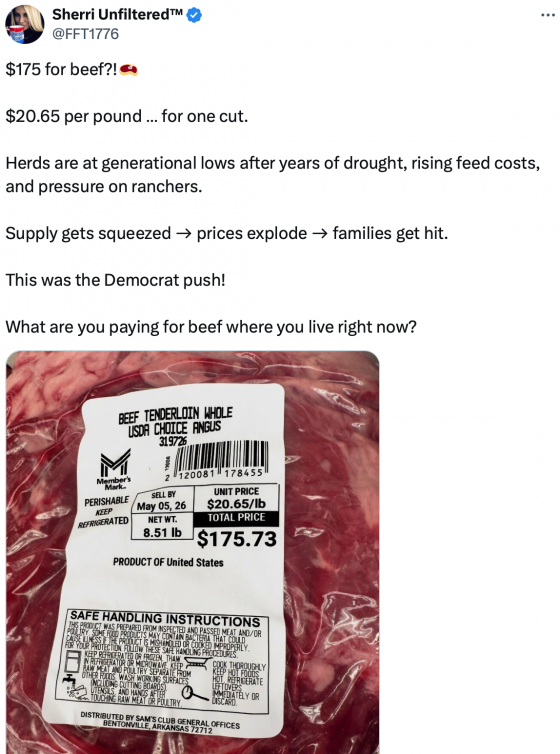
I never thought that I would see beef prices get this high.
But this is the reality that we are living in now.
And it appears that beef prices will continue to remain elevated because the size of the U.S. cattle herd is the smallest that it has been since 1951…
The US cattle herd remained the smallest since 1951 at the start of the year, in the latest signal that consumer beef prices will remain near records.
There were about 86.2 million cattle and calves in the US as of Jan. 1, the US Department of Agriculture said in a Friday report. The tally is nearly unchanged from 2025, providing no relief to the ongoing cattle shortage.
The lack of improvement comes as ranchers keep selling animals to slaughter amid high beef demand, rather than retaining the animals to grow their herds. The downsizing — which began years prior when ranchers shrunk their herds due to high production costs and droughts — has sent consumer beef prices to all-time highs.
It is really hard to feed cattle when conditions are bone dry.
Sadly, they could get even drier in the months ahead…
Meanwhile, there’s a 62% chance of the world’s climate shifting from neutral to El Niño between June and August, according to NOAA’s Climate Prediction Center forecast. The European Center for Medium-Range Weather Forecasts said that this El Niño could be the strongest on record, with peak intensity hitting in October.
El Niño typically results in hot and dry weather in many growing areas, including the U.S. Corn Belt and in Australia. With fertilizer supplies thin, this may further compound production losses for world wheat.
We are being told that we could soon be experiencing a “super El Niño”, and meteorologist Ryan Maue is warning that the long-term forecast for the second half of this year is “off the charts”…
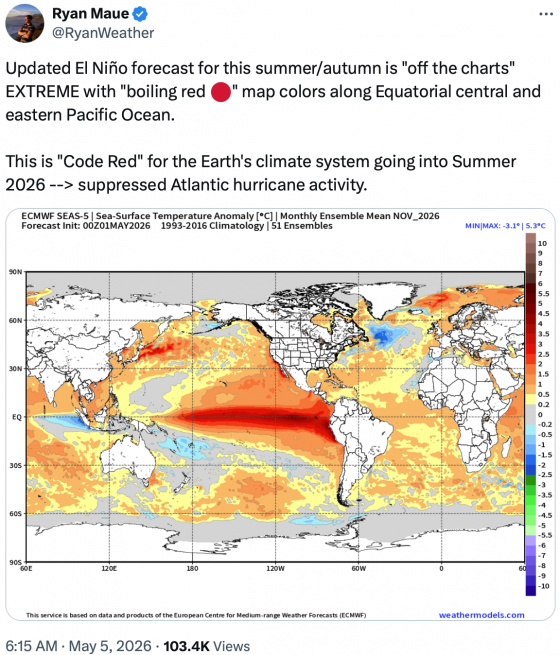
I have been repeatedly warning my readers that global weather patterns are going nuts, and I was not exaggerating one bit.
We really are facing a historic long-term crisis with no end in sight.
As I discussed last week, for the upcoming season U.S. farmers are planting the fewest acres of wheat that we have seen since records began in 1919.
In 1919, there were 104 million people living in the United States.
Today, there are 341 million people living in the United States.
It doesn’t take a genius to figure out that we have a major problem on our hands.
Many of us have been warning about this crisis for years, and now we really have reached a breaking point.
Michael’s new book entitled “10 Prophetic Events That Are Coming Next” is available in paperback and for the Kindle on Amazon.com, and you can subscribe to his Substack newsletter at michaeltsnyder.substack.com.

About the Author: Michael Snyder’s new book entitled “10 Prophetic Events That Are Coming Next” is available in paperback and for the Kindle on Amazon.com. He has also written nine other books that are available on Amazon.com including “Chaos”, “End Times”, “7 Year Apocalypse”, “Lost Prophecies Of The Future Of America”, “The Beginning Of The End”, and “Living A Life That Really Matters”. When you purchase any of Michael’s books you help to support the work that he is doing. You can also get his articles by email as soon as he publishes them by subscribing to his Substack newsletter. Michael has published thousands of articles on The Economic Collapse Blog, End Of The American Dream and The Most Important News, and he always freely and happily allows others to republish those articles on their own websites. These are such troubled times, and people need hope. John 3:16 tells us about the hope that God has given us through Jesus Christ: “For God so loved the world, that he gave his only begotten Son, that whosoever believeth in him should not perish, but have everlasting life.” If you have not already done so, we strongly urge you to invite Jesus Christ to be your Lord and Savior today.
The post Megadrought: We Just Experienced The Driest First Three Months Of A Year In U.S. History appeared first on The Economic Collapse.